
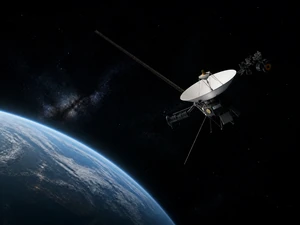
NASA's Voyager 1 Is Now a Full Light-Day From Earth
Thomas Hale
Updated Nov 26, 2026
NASA’s Voyager 1 spacecraft has reached a distance so vast that a radio signal traveling at light speed needs an entire day to get there. On November 18, the probe crossed the one-light-day mark, becoming the first human-made object to reach that distance from Earth after nearly half a century in space.
It is a striking milestone for a machine launched in 1977, before smartphones, the modern internet and the lives of many people now watching its progress. Voyager continues to operate far beyond the planets it was originally built to explore, sending scientific information from interstellar space.
What a light-day means
A light-day describes distance, not a deadline or an amount of time the spacecraft itself has been traveling. Light moves roughly 186,000 miles per second. In 24 hours it covers about 16.09 billion miles. Voyager 1 needed almost 50 years to reach that distance because, fast as it travels by human standards, the spacecraft moves at approximately 38,000 miles an hour.
The communication delay works both ways. A command from Earth takes about a day to arrive, and a reply takes another day to travel home. Engineers therefore operate the craft with extraordinary patience: even a simple exchange cannot happen as a live conversation. It is an extreme example of why deep-space missions require careful planning.
A probe built for Jupiter and Saturn
Voyager 1 began as part of a twin spacecraft mission intended to study the outer planets. It captured landmark observations of Jupiter and Saturn and their moons, helping transform objects that had been little more than points of light into recognizable worlds with storms, rings and complicated surfaces.
Its sister craft, Voyager 2, followed a different path that took it to Uranus and Neptune as well. Both probes ultimately left the heliosphere, the region dominated by the solar wind and the Sun’s magnetic influence, and entered interstellar space. Voyager 1 crossed that boundary in 2012; Voyager 2 followed in 2018.
A record set by a functioning spacecraft
Voyager was not designed to travel for five decades with an unchanging set of instruments. Its long-running mission has required the NASA Jet Propulsion Laboratory to manage aging hardware and limited power, preserving communication and selected scientific operations as the craft moves farther away. That engineering effort is why the light-day record is more than an object drifting into space.
The mission also offers a rare comparison between two paths through the outer solar system. Voyager 1 used a route past Jupiter and Saturn that carried it outward relatively quickly. Voyager 2 went on to Uranus and Neptune, making its planetary tour longer and its trajectory different. The pair gave scientists both a record-breaking distance marker and two probes sampling interstellar conditions in separate directions.
An old recording traveling farther every day
Each probe carries a gold-plated phonograph record with selected sounds and images from Earth. The collection is a symbolic message to anything that might someday encounter the spacecraft, but its immediate importance has always been human: a portrait of what people chose to send away from their planet.
NASA marked the new milestone with a public invitation to shine lights toward the sky and signal V-G-R in Morse code. The ceremony was symbolic, not a method of communicating directly with Voyager. Scientists instead use specialized antennas and radio systems to exchange information across the enormous gap.
The spacecraft now sets a distance record each day simply by continuing along its path. It has outlived many original expectations and is still carrying a record of Earth into the dark. Its one-light-day milestone gives people at home a new way to imagine the distance between a familiar 1970s launch and the edge of what our machines have reached.
References: Voyager One Light-Day Downloads | Voyager - NASA Science | Shine Bright for Voyager’s Light-Day

AI-Assisted Content
The News And Beyond team was assisted by generative AI technology in creating this content.
Trending


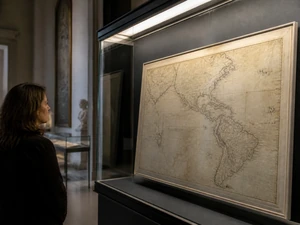
The Map That Named America Goes on Display in Washington
A piece of the 1507 world map that first put the name “America” on a...
Erin Calloway

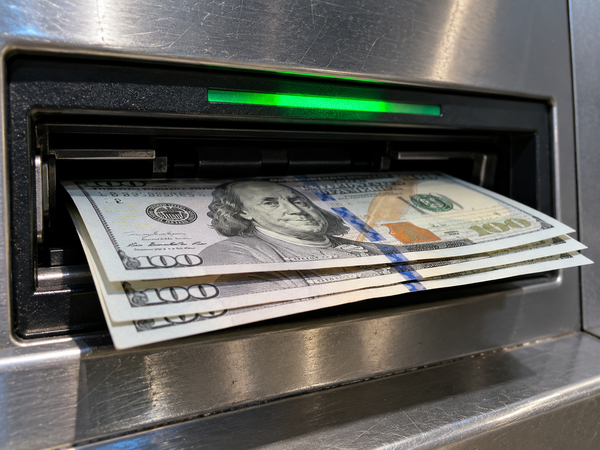
Navy Federal Fraud-Loan Settlement Offers an Extra $250 Claim
Some Navy Federal Credit Union members whose personal loans were disputed as fraudulent may qualify...
Alex Mercer


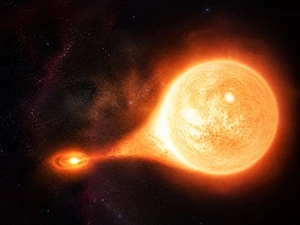
NASA Tracks a Giant Star Swallowing Its Smaller Neighbor
Astronomers have reconstructed a rare cosmic event in which a giant, aging star swallowed a...
Erin Calloway
Halle Berry Already Pays $8,000 a Month. Her Ex Wants More
Caption: Halle Berry at the 2025 Cannes Film Festival. Photo: Gabriel Hutchinson / WikiPortraits /...
Susan Blake

Blink-182's Mark Hoppus Won His Tree Fight. He Still Wants $681,000
Caption: Mark Hoppus performing at the 2020 ALTer EGO concert. Photo: Justin Higuchi / Wikimedia...
Emily Carter


Priscilla Presley Gets Four Claims Tossed. The $50 Million Fight Continues
Caption: Priscilla Presley in January 2022. Photo: ruthdaniel3444 / Wikimedia Commons. Licensed under CC BY...
Emily Carter


Luke Bryan and Jason Aldean Fight $1.4 Million Steakhouse Demand
Caption: Luke Bryan performing at the 2022 Gershwin Prize concert. Photo: Shawn Miller / Library...
Emily Carter


Sydney Sweeney's Ad Was Followed by a $1.8 Billion Novig Month
Caption: Sydney Sweeney at the 2024 Toronto International Film Festival. Photo: Jay Dixit / WikiPortraits...
Erin Calloway

Dorit Kemsley Finds a New Home After $7 Million Mansion Dispute
Caption: Dorit Kemsley in a 2016 video still. Photo: The Street Interviewer / Wikimedia Commons....
Susan Blake

Renters Could Share $48.5 Million in Settlement Funds
Renters affected by alleged hidden fees and improper security-deposit deductions at Progress Residential could receive...
Ryan Ellis